Taste as Experience by Nicola Perullo
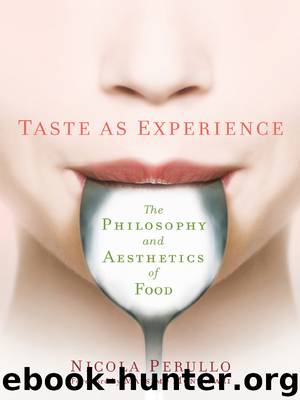
Author:Nicola Perullo
Language: eng
Format: epub
Tags: PHI001000, Philosophy/Aesthetics, SOC055000, Social Science/Agriculture & Food
Publisher: Columbia University Press
Published: 2016-04-04T16:00:00+00:00
CURIOSITY, EXPERTISE, CRITICISM (WITH RISKS INCLUDED)
Walter Benjamin believed architecture to be an emblematic case of an art that has a collective and routine use. The appropriate experience of architecture—precisely because it responds to practical uses and because its original function is not visual contemplation but rather dwelling interaction—amounts to a perception that he defined as “distracted.” The question posed by Benjamin was part of a major aesthetic debate regarding the nature of a work of art. In the wake of Benjamin, we can address in our context the following similar question. Do food experts and critics, with their analytical dissections of gustatory processes, incarnate the most appropriate way to live taste perception? From an evolutionary point of view, the first and primary function of food has been to feed and to feed well. In parallel, the first and primary function of taste has been to escape harmful and toxic foods, and then to make us feel good and give us pleasure. An aesthetics of taste should start then from this fact: all edible matter, even the most refined, is picked, bred, or made to be eaten. And all food, even that of the most refined gastronomic quality, retains its nutritional and energy-providing function. Why then should we assume that the cultivation of gustatory perception aimed at appreciating taste stems from the removal of this very basic but essential fact in favor of a mere analysis of flavor? I believe this approach depends on the preponderance of the visual and contemplative paradigm of aesthetics, according to which the true appreciation of food and drink must pass through an analytical exploration made by our sensory/perceptual apparatus. The haptic process of tasting is then considered as if it were observed by an eye. However, this approach surreptitiously presupposes what it sets out to prove, namely, that to appreciate food requires analyzing it in discrete terms, dissecting the object of appreciation into separate moments like the color, the odor, the taste. I do not reject the legitimacy of food being appreciated also in reflective and analytical ways, as I suggest that taste perception is molded in many different environmental experiences that take many different forms. I am merely asserting that this is not the only possible approach or the only way to appreciate it. We can appreciate food aesthetically also taking a different way, just considering its physical and psychological effects and its transformation into energy for life. This implies accepting a different conception of aesthetics, based on material contact, assimilation, and metabolism. To wholly understand the aesthetics of taste, it is necessary to go beyond the privilege of vision and the formal perspective that supports it. We should value instead the vital and metabolic aspects, as well as transformation and change, because taste always leaves a trace, even if you cannot see it.
Adult, thoughtful, and cultural gustative appreciation passes through different stages. Historical and anthropological curiosity is usually the first stage. Bertrand Russell was not particularly interested in food, but he was a curious and certainly very intelligent person.
Download
This site does not store any files on its server. We only index and link to content provided by other sites. Please contact the content providers to delete copyright contents if any and email us, we'll remove relevant links or contents immediately.
Whiskies (Collins Gem) by dominic roskrow(45213)
101 Whiskies to Try Before You Die by Ian Buxton(44974)
World's Best Whiskies by Dominic Roskrow(44876)
Whiskies Galore by Ian Buxton(41962)
The Fast Metabolism Diet Cookbook by Haylie Pomroy(21113)
Chic & Unique Celebration Cakes by Zoe Clark(20038)
Craft Beer for the Homebrewer by Michael Agnew(18218)
The Bone Broth Miracle: How an Ancient Remedy Can Improve Health, Fight Aging, and Boost Beauty by Ariane Resnick(16587)
For the Love of Europe by Rick Steves(13791)
Tools of Titans by Timothy Ferriss(8345)
A Court of Wings and Ruin by Sarah J. Maas(7778)
How to Be a Bawse: A Guide to Conquering Life by Lilly Singh(7455)
Chowders and Soups by Liz Feltham(7344)
The Institute by Stephen King(7014)
Cravings: Recipes for All the Food You Want to Eat by Chrissy Teigen & Adeena Sussman(6768)
Wiseguy by Nicholas Pileggi(5740)
The Last Wish (The Witcher Book 1) by Andrzej Sapkowski(5440)
Spare by Prince Harry The Duke of Sussex(5162)
Room 212 by Kate Stewart(5087)
